

Read Time: 10-12 minutes
Quick Answer
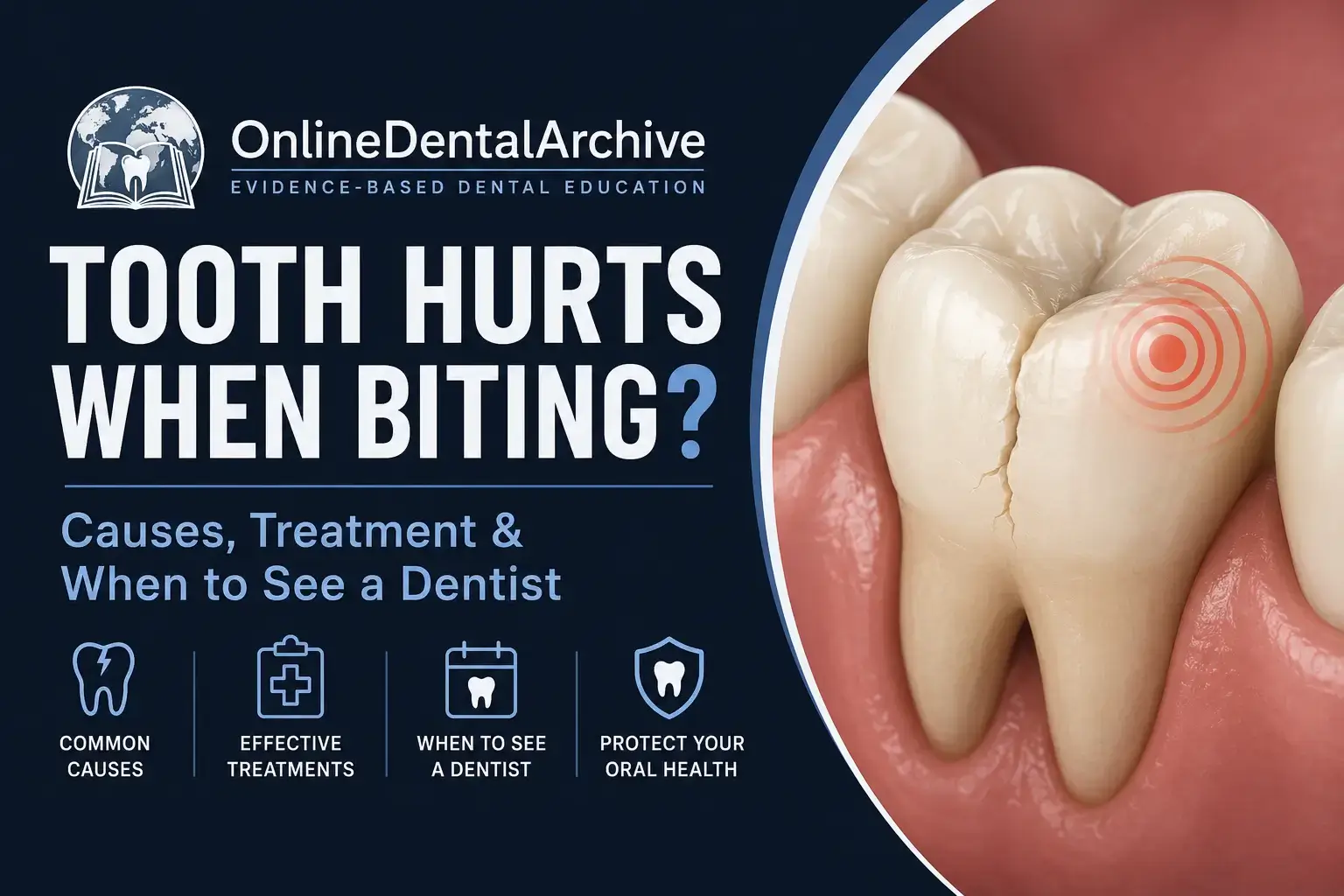
A tooth that only hurts when biting down can be caused by several conditions such as a cracked tooth, a high filling, an inflammation of the ligaments surrounding the tooth, tooth decay that reached the nerves, or a dental infection. These conditions can cause similar symptoms so to identify the exact cause, a dental examination has to take place.
Quick Summary
- Tooth pain only when biting is usually caused by pressure on an injured tooth or its supporting tissues.
- Tooth pain when biting is not a diagnosis—it is a symptom
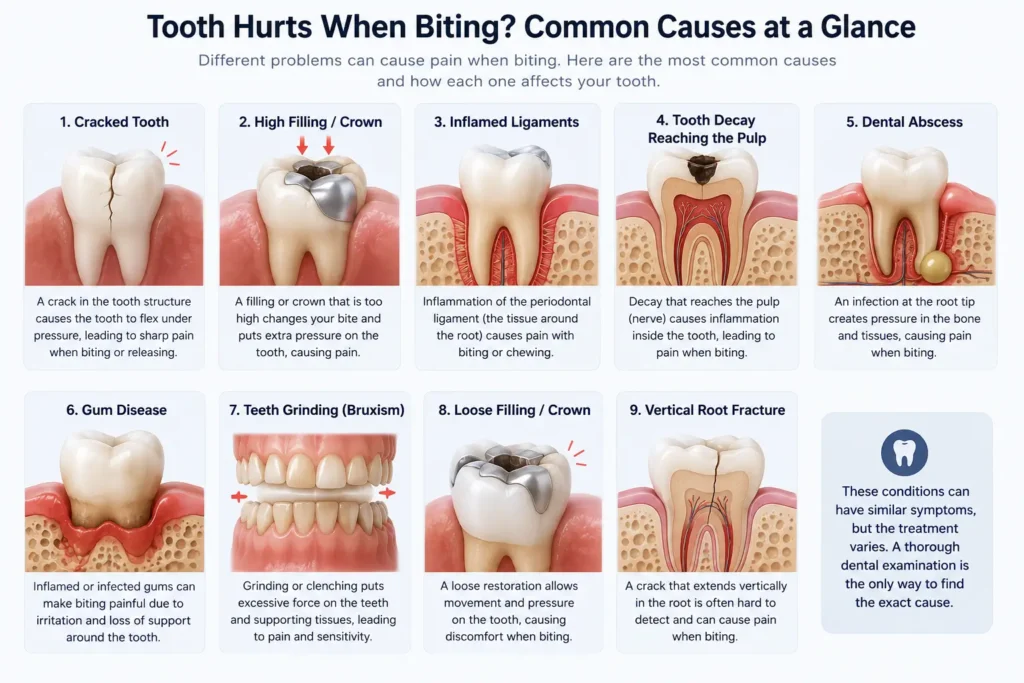
- Common causes include cracked teeth, high fillings, ligament inflammation, tooth decay reaching the pulp, and dental abscesses.
- The pattern of pain (when biting down or releasing the bite) can help identify the cause.
- Persistent pain, swelling, or pain with fever should be evaluated by a dentist promptly.
Some causes for tooth pain on biting are relatively minor and easy to be treated, while others would require urgent dental treatment to prevent it from becoming worse.
The most common causes:
- Cracked Tooth
- A high filling / crown
- Inflammation of supporting tooth ligaments
- Tooth decay (caries) reaching the nerves
- Infection or dental abscess
- Gum disease
- Trauma from clenching / grinding your teeth (bruxism)
The only reliable way of determining the exact cause is by a thorough dental examination, taking a history of the pain like “When did it start? What causes the pain? Where do you feel the pain coming from?” as well as taking a radio-graph (X-ray) and other clinical tests.
Why Does Biting Cause Pain?
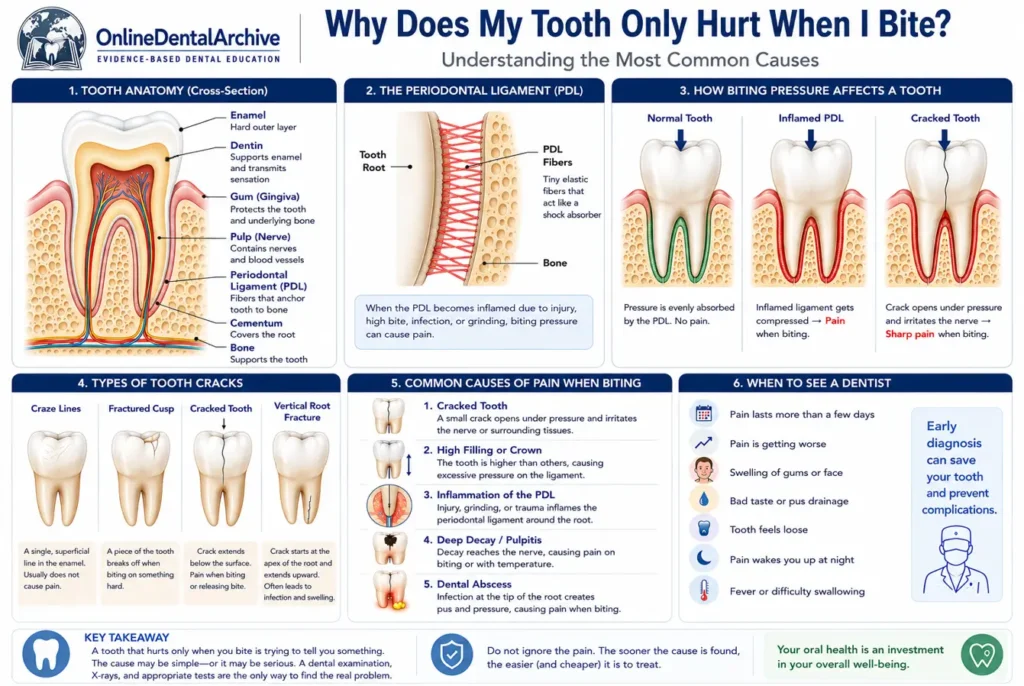
During chewing or biting, your tooth gets exposed to masticatory forces that happen in different directions. These forces travel through a complex structure made of enamel, dentin, root, pulp, periodontal ligaments and finally the surrounding bone.
Your enamel is the outermost protective layer, while dentin is connected to your pulp by small tubes and is a sensitive hard layer. Pulp is where you have the bundle of nerves and blood supply. Periodontal ligaments are small fibers that suspend your tooth from its root in a socket made of bone and act as a cushion or a pillow.
When all of these layers are healthy working in harmony, your tooth can withstand these forces. However, if any of these structures are damaged or inflamed, the tooth may be receiving excessive forces on it or not able to withstand normal biting force.
Two patterns may be observed
-Pain when biting down
-Pain when you release the bite
The pattern can give your dentist a clue on what the underlying cause might be
What Does the Pain Feel Like?
Patients describe the pain in many different ways, like:
- Sharp pain when chewing
- Pain that disappears after biting
- Pain when eating hard foods
- Dull aching pain after chewing
- Feeling like the tooth is “bruised”
- A sense of feeling that the tooth is taller than others
The type of pain, when it happens, what causes it and the severity all help with the diagnosis
|
Cause |
Urgency |
|---|---|
|
Cracked tooth |
Moderate |
|
High filling |
Low |
|
Abscess |
High |
|
Gum disease |
Moderate |
|
Bruxism |
Low |
|
Root fracture |
High |
1. Cracked Tooth (One of the Most Common Causes)
A cracked tooth is one of the leading common causes of pain during biting. The crack might be so small that it’s not visible to the naked eye during examination with a mirror. When you bite down, the margins of the crack open slightly and when releasing the bite, it closes again. This creates an irritation in the dentin layer producing pain on either biting or releasing the bite.
Many patients describe:
- Pain when biting hard food or meats
- Pain or sensitivity to cold
- Pain with sweets
- Pain when releasing the bite
Cracks develop commonly with:
- Older patients
- Root canal filling
- Biting on hard objects
- Teeth grinding (bruxism) or clenching
- Trauma to the mouth
Most often, cracks are not visible in regular X-rays because of the 2D nature of the image, so a healthy tooth surface can cover over a crack on the opposite tooth surface. Dentists will use different methods to detect a crack like bite tests, dyes, magnification, or trans-illumination to identify the location of the crack. Treatment or no treatment, the method used depends on the extent and location of the crack.
2. A High Filling or Crown
After getting a tooth filling or a crown, some patients might notice pain only when biting or chewing food. If the filling or crown is slightly higher than your natural tooth and its surrounding teeth, it can change how your bite closes together, and the dynamics of chewing. Instead of the forces being shared evenly, the forces get more concentrated on those high spots of the restoration. This create an excessive force that irritates your periodontal ligaments that cushions your tooth, and causes discomfort or pain when biting. Fortunately, this is a very easy problem to correct and your dentist can adjust it in a few minutes
3. Inflammation of the Periodontal Ligaments
Teeth are separated from the bone in its socket by fibers called the periodontal ligaments. These ligaments act as a cushion or a shock absorber. When these ligaments become inflamed, chewing or biting can become painful
Common causes include:
- Heavy biting forces
- Teeth grinding (bruxism)
- Trauma
- High fillings/crown
Patients might describe the tooth as loose, sore, or taller than surrounding teeth
The cause has to be identified, if it is a high restoration then it can be corrected. If it is due to a trauma, then the trauma has to be assessed. Heavy biting forces can be managed in different ways according to the cause and severity. Teeth grinding will require a night-guard as well as the reason of why bruxism or clenching happens.
4. Tooth Decay Reaching the Pulp
Small cavities rarely cause pain on biting. However, once the decay reaches the pulp, inflammation of the pulp starts to develop.
As the inflammation increases, pressure builds up inside the pulp as it is surrounded by hard structure called dentin. This pressure, alongside pressure from biting causes pain.
Symptoms may include:
- Sensitivity to cold
- Sensitivity to hot
- Pain that lingers
- Night tooth pain
The pulp can have two stages for inflammation, one is reversible and can be treated by removing the cause. The second is irreversible and is treated by doing a root canal treatment and removing the pulp.
5. Dental Abscess
A dental abscess is an infection around the roots of teeth. This infection creates pressure around the root and bone, with biting down creating more pressure that could lead to extreme pain.
Symptoms of abscess may include:
- Pain when biting
- Swelling of gums
- Swelling of face
- Pus drainage and bad or metallic taste in mouth
Dental abscess can not be ignored and is a serious condition. It can not be treated by antibiotics and physical removal of infected tissue has to be done by a dentist.
6. Gum Disease
Pain on biting does not have to originate from the tooth itself but can originate from the supporting structures around it. Advanced gum disease damages the gum, periodontal ligaments and bone and can cause loss of these structures that can be permanent.
Symptoms may include:
- Bleeding gums during eating/brushing
- Loose teeth or mobility
- Bad breath
- Gum recession
- Spaces between teeth where gums had filled
7. Teeth Grinding (Bruxism)
Many people grind or clench on their teeth while awake or sleeping without them realising that. Over time, this excessive pressure can cause inflammation of supporting tissues, and grinding can cause wear of teeth.
Patients that grind while asleep wake up with:
- Sore teeth
- Jaw pain
- Headaches
The discomfort usually improves during the day but returns after sleeping again.
Night guards can help protect the teeth at night, but treatment should be based on the assessment of the professional for each individual.
8. Loose Filling / Crown
Old fillings and crowns can become loose over time. Fillings can get chipped, or leakage around the margins of the filling. While cement holding the crown may weaken over time and cause looseness.
You may notice:
- Pain or discomfort when chewing
- Food getting stuck
- Sensitivity to cold
Your dentist can restore or replace the restoration depending on the case, and can re-cement the crown after examining it. Some cases might need a crown replacement
9. Vertical Root Fracture
While not common, it is a serious condition. Vertical Root Fracture is when a fracture starts at the tip of your root extending all the way up and is most commonly found with teeth that had complex procedures done and specifically root canal treatment.
This condition is often mistaken for other diseases involving supporting structures or failed root canal treatment.
Symptoms may include:
- Tooth mobility, but many teeth are stable
- Mild pain on biting
- Swelling around the tooth
Unfortunately, treatments for root fractures often involve removal of the fractured root in multi-rooted teeth, or extraction of the tooth in single rooted teeth. There are other treatment modalities but with limited documentation.
Does It Hurt When You Bite or When You Let Go?
Dentists will often ask this question as it provides useful information for diagnosis.
Pain while biting down might suggest inflammation of peridontal ligaments, a high restoration or an infection. While pain when releasing pressure is commonly associated with Cracked Tooth Syndrome, although not unique to it.
A thorough examination has to take place, with history of the problem from the patient, clinical findings and radiographic findings.
How Does the Dentist Find the Cause?
Your dentist might perform several steps:
- Medical and dental history
- Clinical examination
- Bite test
- Percussion test
- Cold/Hot test
- Radiographs (X-rays)
Can the Tooth Heal by Itself?
Minor irritations from clenching, temporary bruxism during stressful times, or biting on something hard will resolve after some time.
However, problems such as:
- Cracked teeth
- Tooth decay
- Abscess
- Advanced gum disease
- Vertical Root Fracture
- High or loose restoration
Will continue to worsen if left untreated. Waiting too long might make a small problem become more complicated.
When Should You See a Dentist?
You should arrange a dental appointment if:
- Pain lasts more than one or two days
- Chewing/Biting becomes increasingly painful or uncomfortable
- Tooth becoming sensitive to cold or hot
- Any swelling
- Bad taste or metallic taste
- Pain that wakes you at night
- Tooth becoming loose or mobile
- Pain that return repeatedly
Seek urgent dental care if you experience any face swelling, difficulty in swallowing, difficulty in breathing or developing a fever with painful tooth.
Frequently Asked Questions
Final Thoughts
A tooth that only hurts when biting is sending an important message: something is not functioning normally. The cause may be as simple as a night-guard or a tooth filling, or as complex as vertical root fracture or an infection that requires more extensive treatment.
Simple conditions can turn into complex ones, as it progresses and worsens over time. Because many of these conditions share similar symptoms, an accurate diagnosis by a professional is essential. The more information you could share with your dentist regarding the pain, what initiates it, when did it start, which side right or left, or upper and lower jaw all help the dentist to make an accurate assessment. The sooner the problem is identified, the better the outcome of the treatment and the higher the chance of preserving the tooth.
References
- Abbott, P., & Leow, N. (2009). Predictable management of cracked teeth with reversible pulpitis. Australian dental journal, 54(4), 306–315
- Hargreaves K. M., Berman L. H. & Rotstein I. (2021). Cohen’s pathways of the pulp. St. Louis: Mosby-Elsevier.
- Rivera, E.M. and Walton, R.E. (2015), Longitudinal tooth cracks and fractures: an update and review. Endodontic Topics, 33: 14-42.
- Bartolucci, M. L., et al. (2023). Sleep Bruxism and Orofacial Pain in Patients with Sleep Disorders: A Controlled Cohort Study. Journal of Clinical Medicine, 12(8), 2997.
- Tonetti MS, Greenwell H, Kornman KS. Staging and grading of periodontitis: Framework and proposal of a new classification and case definition. J Periodontol. 2018;89(Suppl 1):S159–S172.
- European Society of Endodontology (ESE) developed by:, Duncan, H. F., et al. (2019). Management of deep caries and the exposed pulp. International endodontic journal, 52(7), 923–934.